
Children Don’t Need Simpler Art. They Need Honest Art.
Across sixty-plus commissioned projects over fifteen years, I’ve learned this: children recognize condescension instantly. They also recognize when art trusts them to think.
This matters especially now, as public art in schools increasingly defaults to cheerful simplification — bright, safe, and forgettable. The intention is good. The result often isn’t. Children deserve better than work that assumes they need to be managed rather than engaged.
They deserve complexity, historical honesty, and art that rewards repeated looking.
Here’s what that looks like in practice.
Children Encounter Art Differently — Not Less Deeply
Adults often approach art asking, What does this mean?
Children ask, What’s happening here?
That difference is crucial. Meaning, for children, is not extracted — it’s assembled. They notice details adults pass over. They invent connections. They return to the same image again and again, finding new things as they grow.
In schools especially, art is not encountered once and then forgotten. It lives in corridors, stairwells, libraries — places children pass through daily. Over time, it becomes part of their environment, their memory, and their sense of place.
That’s why I design school-based public artworks to operate on multiple registers at once:
Immediate visual engagement
Dense imagery that rewards curiosity
Historical or social references that remain open rather than didactic
This layered approach mirrors how children actually learn: not linearly, but recursively.
Complexity Is Not the Same as Confusion
One of the most common concerns raised around educational art is that complexity might overwhelm students. In my experience, the opposite is true.
Children are overwhelmed by:
Visual noise without structure
Messaging that insists on a single “correct” interpretation
Work that talks at them rather than inviting them in
They are not overwhelmed by density, ambiguity, or layered narratives.
In fact, children are often more comfortable with uncertainty than adults. They don’t need everything resolved. They are content to explore.
This is why I avoid heavy-handed explanatory text embedded directly into artworks. Context can be provided through conversation, teaching, and time. The artwork itself should remain open — a space for looking, questioning, and return.
In Practice: What This Looks Like
In large-scale public artworks created for school environments, I’ve worked with layered collage incorporating historical photographs, archival materials, and symbolic imagery.
What I’ve consistently observed is this: students don’t need instructions to engage. They invent their own narratives. They point out details to one another. They ask questions that change over time.
Teachers have reported that the same work functions differently across grade levels. Third graders notice one set of things. Eighth graders notice another. The same student, encountering the work year after year, finds new meaning as their understanding grows.
This is what “age-appropriate” actually means: not simplified, but structured for deepening discovery over time.
Respecting the Intelligence of the Viewer
Talking down to children usually takes one of two forms.
The first is aesthetic infantilization: bright colors without intention, cheerful imagery without depth. The second is moral simplification: art that announces its lesson so clearly that interpretation becomes unnecessary.
Both approaches underestimate children’s intelligence.
Respect does not mean making work obscure or inaccessible. It means assuming the viewer is capable of interpretation — even if that interpretation is emotional, partial, or provisional.
Children understand that the world is complicated long before adults are comfortable acknowledging it. What they need is not simplification, but framing.

What children respond to is sincerity: work that trusts them to think.
Care, Safety, and Responsibility
Of course, making work for schools carries real responsibility. Children deserve environments that are physically safe, emotionally considerate, and thoughtfully designed.
I approach this responsibility through design rather than censorship.
Scale matters. Placement matters. Sightlines, lighting, and pacing all affect how work is received. A piece designed for a busy corridor must operate differently than one in a library or stairwell.
This is why my public art projects are always site-responsive and developed in conversation with architects, administrators, and educators. The work is not an isolated object — it’s part of a living environment shaped by daily use.
Art as a Civic Presence
Schools are civic spaces. They communicate values whether we intend them to or not.
Public art in these spaces should neither retreat into bland neutrality nor overwhelm with messaging. Instead, it should model what thoughtful civic engagement looks like: curiosity, plurality, care, and attention.
History-based and research-driven imagery is especially powerful here. History teaches complexity without preaching. It shows how people live inside systems, resist them, change them, and are changed by them.
Children understand stories of struggle and solidarity instinctively. They do not need them simplified — they need them humanized.
Credibility and Continuity
My approach has been supported by institutions including the Canada Council for the Arts, the New York Foundation for the Arts, and the Durst Organization, and realized across more than sixty commissions for schools, libraries, and public institutions.
Across contexts and communities, the lesson has been consistent: children respond to sincerity, craftsmanship, and trust.
They notice quality. They notice care. And they remember it.
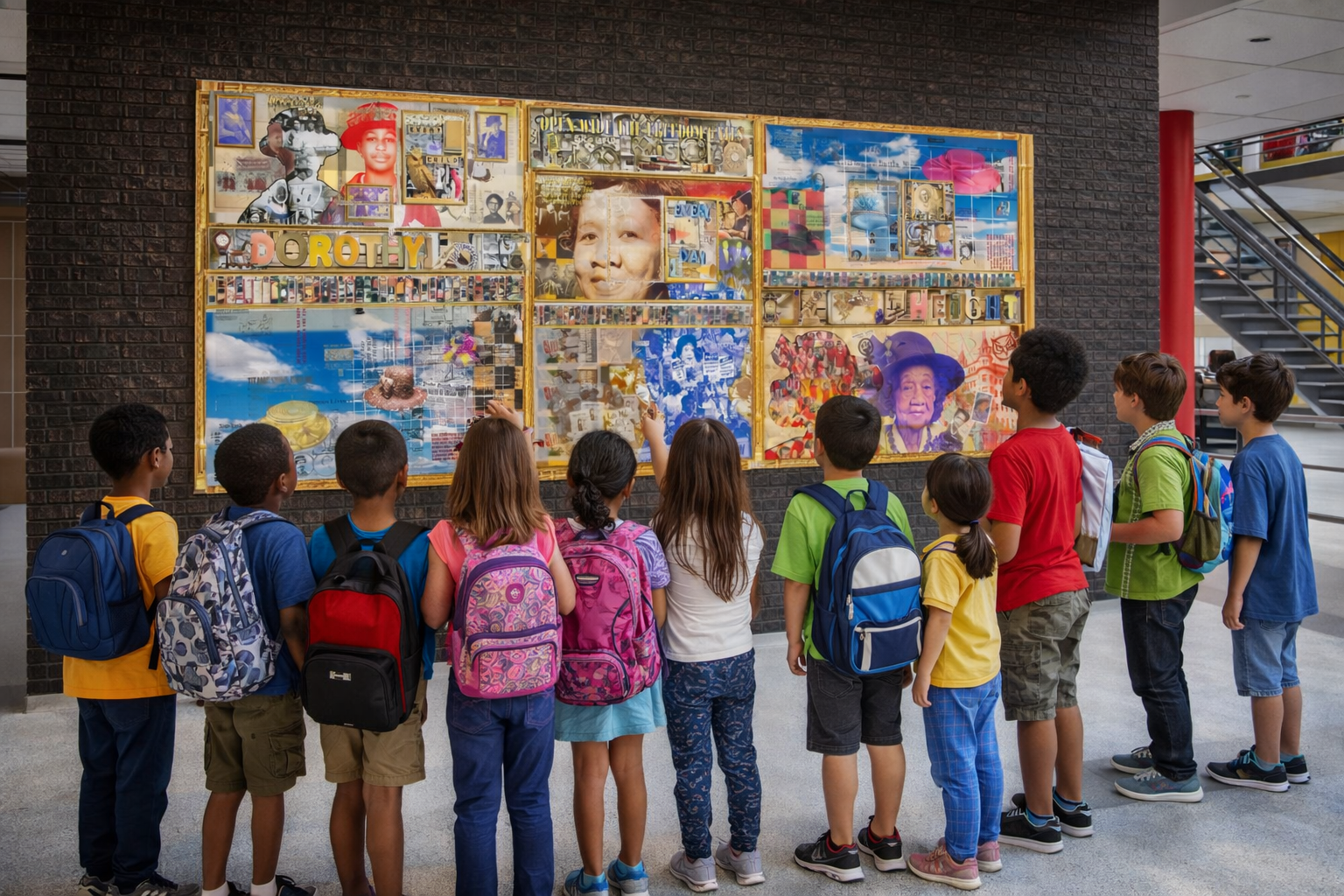
Respect does not mean making work simpler. It means trusting the viewer.
Trust Works
Making work for children without talking down to them requires trust — that children are capable of curiosity, that educators can contextualize when needed, and that ambiguity enriches rather than confuses.
It also requires craft. Children are discerning viewers. They know when something is made with care.
My role is to create work that opens space rather than closes it — work that invites looking rather than instructs, that acknowledges young viewers’ intelligence without demanding they understand everything at once.
Schools remain one of the few places where long-term thinking still matters. Public art in these spaces should rise to that challenge — not by simplifying the world, but by offering children the tools to encounter it honestly.
This approach informs all of my public art practice, from school commissions to community-based installations. [See examples in my public art portfolio →]